
Sumter Previous Residents Sources
Researching previous residents works best as a dated address trail. A parcel map can orient the location, a recorded instrument can identify parties to that document, and a historical directory can supply an occupant or use for a specific printed edition. Those are separate forms of evidence. A deed grantee is not automatically an occupant, and an old directory line is not a modern address claim. Preserve the source date, the address as printed, and the custodian for every step.
| Source | Years it covers | Where held | What it shows |
|---|---|---|---|
| Recorded land instruments | Online coverage not verified | Sumter County Register of Deeds | Document parties, recording references, and legal descriptions |
| Walsh City and County directory | 1905-06 | UofSC Digital Collections | Name, residence or occupation-style listings, and street department clues |
| Sanborn fire-insurance maps | 1902 | Library of Congress | Street layout, building footprints, and historic use context |
| Sumter Museum Archives | 1740-present scope statement | Sumter Museum | Plats, photographs, manuscripts, books, and old Sumter District material |
| Historic death-index material | 1915-1967 | South Carolina DPH | A dated event lead, not a full certificate |
Start with the source closest to the period in question. A 1905 address belongs first with the Walsh volume and a 1902 map, not with a current parcel display alone. For an older or unclear legal description, ask the Register of Deeds or Museum for the record that links the historic wording to later evidence.
Sumter Address Before Names
Set the location before following a name. The City and County parcel-road-address viewer provides map context for roads, parcels, subdivisions, City limits, and other public layers. Record the address form and any displayed parcel or location identifier. Use the County’s designated real-property route as a property-card lead, then confirm what the active page currently offers before relying on an interface field.
Keep three labels separate: the physical or situs address, the mailing address, and the legal description. The first identifies a location, the second handles delivery, and the third is the land wording used in a recorded document. A parcel number is a useful research key. It does not identify a household. Where a mailing ZIP matters, validate it with the USPS ZIP Code Lookup, then retain the historic address exactly as a directory or map printed it.
Note: The City-limit layer, a postal ZIP, and a parcel boundary answer different questions and should never be substituted for one another.
Sumter Deed Chain Records
The Sumter County Register of Deeds gateway is the official online route for recorded land research. The Register of Deeds maintains recorded instruments such as deeds, mortgages, releases, plats, easements, and powers of attorney. In this research pass, the gateway did not provide reproducible controls, historical coverage, image access, subscription rules, or fee details. Verify those facts on the live portal or with the office at 141 N. Main Street, 803-436-2177.
A useful backward trail moves through the documents, not through a guessed personal profile. Start from the parcel or legal-description lead, identify an instrument reference, record its type and date, then follow the cited prior instrument or the parties as printed. Each document needs its own source date. A recorded instrument can be a link in a chain, but it is not a complete title opinion or proof that a named party lived at the site.
The image below is from the County-linked Register of Deeds index gateway.
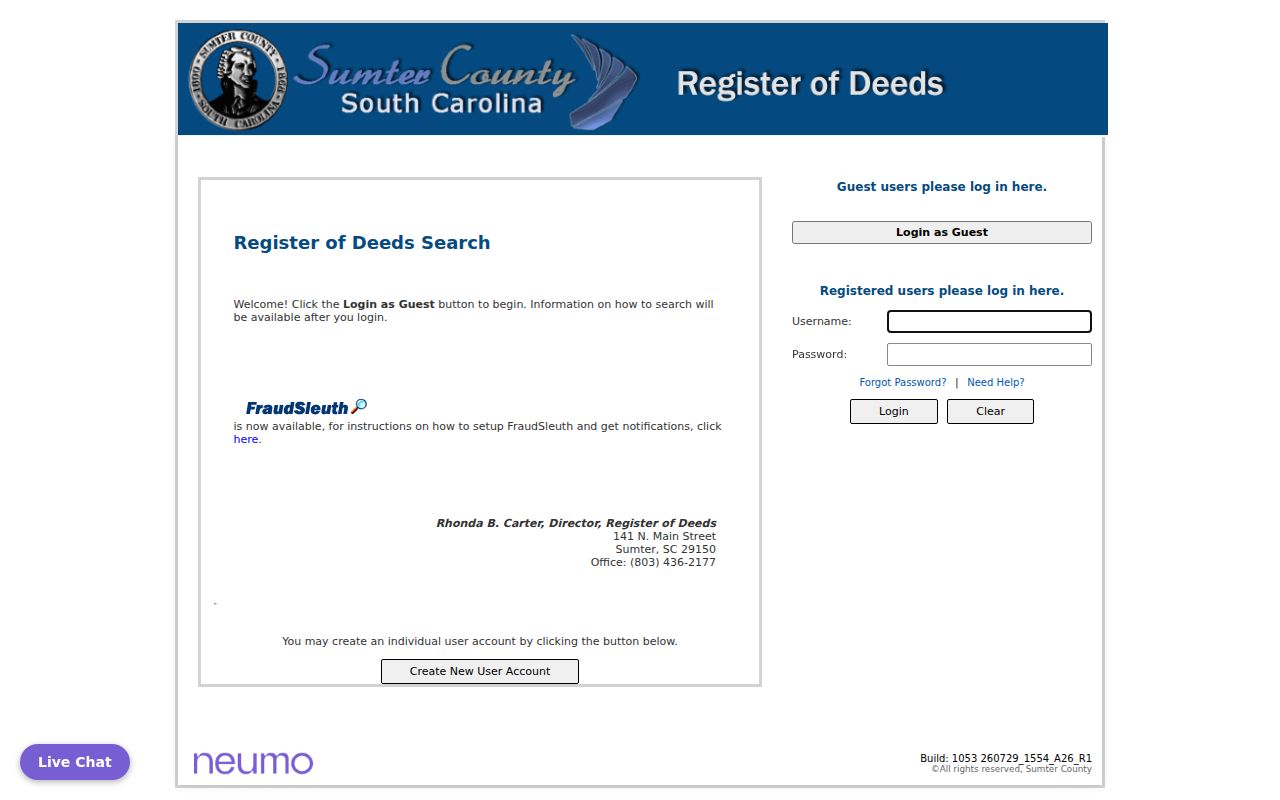
The gateway is a starting route for an instrument search. Confirm its active fields and access conditions with the Register of Deeds before describing a search method or expecting an image.
- Map the address and preserve the available parcel identifier, address wording, and map date.
- Check the County property route for a current property-card lead, while keeping its assessment role separate from recorded evidence.
- Use the Register of Deeds route or office to locate the relevant instrument by the best verified reference available.
- Record the document type, recording date, grantor and grantee spellings, legal description, and any prior-instrument citation.
- Follow the prior citation or a party name as printed, repeating the source record for each earlier link.
- Grantor
- The party who conveys an interest in a recorded instrument.
- Grantee
- The party who receives the interest stated in that instrument.
- Chain of title
- A documented sequence of recorded instruments relating to an interest in land, not an unsupported list of people.
- Legal description
- The land description in a deed or plat, often using lot, block, subdivision, metes and bounds, or a prior reference.
Sumter Historic Street Evidence
The historical address layer needs its own evidence. Walsh's 1905-06 directory has a street department that organizes a house number with an occupant or use. The Library of Congress 1902 Sanborn set has nine Sumter sheets that show street layout, structures, and use context. These sources can help establish what a location looked like at a date. They do not establish a legal boundary, ownership, or a seamless conversion to a modern address.
The historic survey describes development near Main Street, later growth toward Calhoun, Hampton, and North Main, expansion toward the railroad, and mid-century subdivision plats. That changing pattern is one reason an old number should be kept intact until a recorded plat, deed description, or dated map supports a connection. Research found no authoritative Citywide renumbering or street-renaming conversion table for Sumter.
The image below comes from the digitized Walsh directory source.
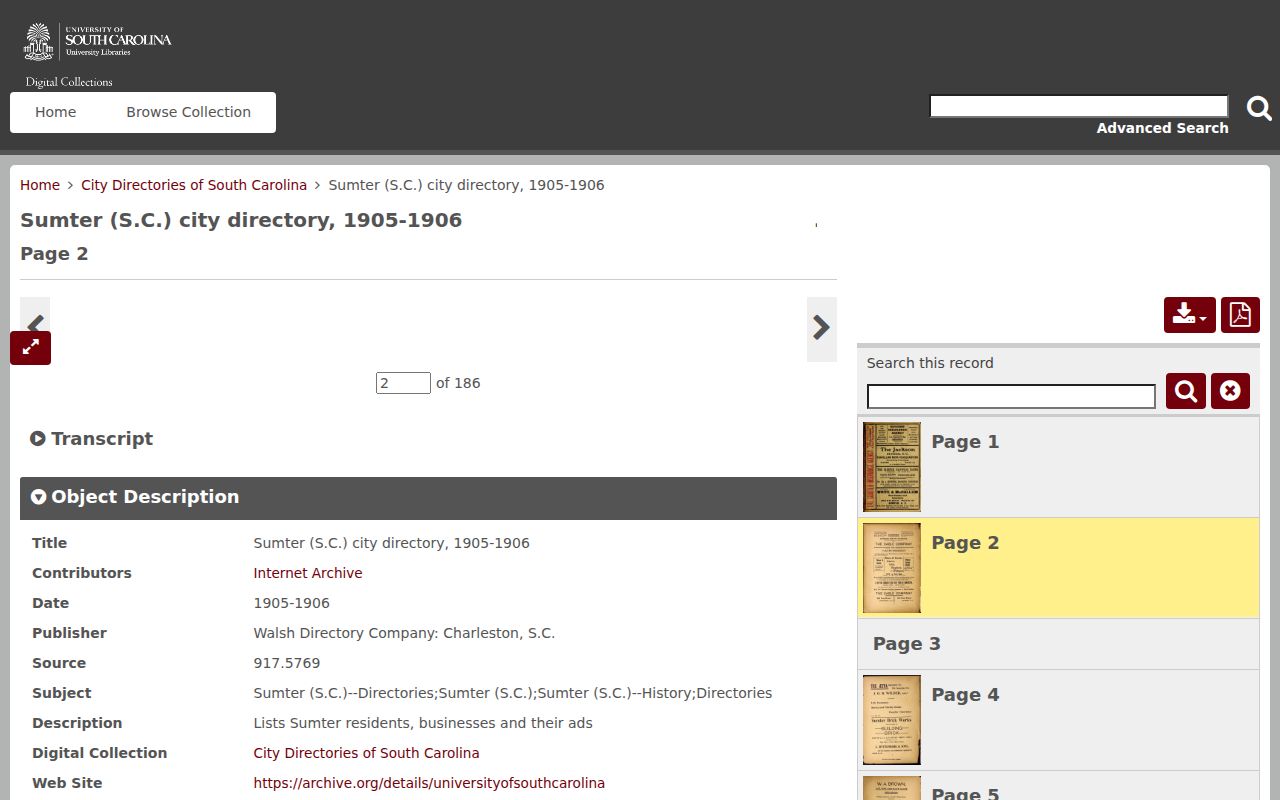
Use the cited edition and its street department as historical evidence, then compare it with a map or recorded record from a compatible time period.
Sumter Previous Residents Directories
Directories can add a household-level lead that land records alone cannot supply, but each entry remains time-bound. In the Walsh volume, the general directory can associate a name with a residence and occupation, while the street department can organize an address with an occupant or use. A departure from one edition can mean many things, including a move, a death, a spelling change, a publication choice, or a gap in the surviving record. It does not settle the reason on its own.
For a detailed explanation of the verified volume and how to read its entry types, use the Sumter city directory collections. Pair a directory year with a historical census or archive index only after recording the address and source date. The useful sequence is: historic address as printed, directory page, map edition, parcel or plat clue, recorded document, then a repository question if a conflict remains.
- Copy the name, address, page, and edition from the directory without modernizing the street form.
- Check the street department and the period’s Sanborn sheet for an address or block clue.
- Use a census or historical index from the same general period as a separate, dated comparison point.
- Compare a legal description or plat reference before connecting the historic address to later land records.
- Keep conflicts visible and ask the Museum, Library, or Register of Deeds for the custodian record that may resolve them.
Note: A historical directory can suggest who lived here before during its publication period, but it cannot identify a present household or resolve a same-name match alone.
Sumter Museum House Research
The Sumter Museum Archives is the local route for a house-history question that needs photographs, plats, manuscripts, books, or old Sumter District material. The Museum says archival research is by appointment and directs genealogy inquiries to the Sumter County Genealogical Society. Bring a packet rather than a broad name request: note the historic jurisdiction, name variants, date range, address as written, and the directory, map, or deed reference already reviewed.
SCDAH describes the Museum’s scope as extending from 1740 to the present and including journals, correspondence, photographs, military material, Thomas Sumter Papers and Draper manuscripts, and Sanborn maps. That describes repository scope, not a guarantee that a given house, family, or street has a searchable file. Museum staff can clarify holdings and access conditions.
The image below leads to the Museum archive and genealogy-research route.

The Museum contact is the appropriate next step when a dated directory, map, or recorded instrument points to a local historical collection.
Sumter Previous Residents Probate
An estate record can be a useful historical lead when a directory name or recorded document points to a probate case or estate number. The Sumter County hub directs visitors to Probate resources, while the Clerk and court systems keep their own records. Preserve the case or estate number, filing date, legal-description reference, and source date. A probate lead may connect a property question to a filed record, but it does not by itself establish heirs, present ownership, or a household relationship.
Ask the named custodian about the file and its access conditions rather than inferring a result from a surname. Where an estate document cites a parcel, plat, or prior instrument, return to that exact reference in the recorded-land trail. This keeps previous-residents research anchored to documents and dates instead of joining separate people or addresses by assumption.
Sumter Previous Residents Limits
Past residents research has firm boundaries. A parcel map is geographic context. A property card is an assessment lead. A recorded instrument documents a transaction or filing. A historic directory records a published entry for one period. None alone establishes present residence, household membership, family relationships, or a complete history. Court, vital, and election records have their own custodians and may be restricted or redacted.
If an official display contains an error, contact the custodian that owns it: mapping staff for a map or address display, the Register of Deeds for a recorded-document question, the Clerk for a court filing, DPH for a vital record, or Voter Registration and Elections for a registration issue. The South Carolina Address Confidentiality Program is an official protection route for eligible participants; custodians must follow its rules and other required redactions.