
Finding Sumter Residents Through Records
Sumter has no official all-purpose household roster. The useful route depends on the question. For a place, begin with the City and County map, then preserve the parcel or legal-description clue before moving to the County property route or a recorded instrument. For a case, begin with the court level and the Judicial Branch index. For a historical name or address, start with the exact year and use the Walsh directory, maps, Library, Museum, and archives as dated sources. A record can establish only what its custodian keeps.
Property, election, court, vital, and archive systems are separate. An assessment owner is not necessarily an occupant. A deed party is not necessarily a present owner. A historic directory entry is evidence for its publication period, not a present address. That separation makes a Sumter residents directory more accurate and helps avoid a wrong-person match.
- Write down the exact name, address, or year already known, plus the source date.
- For an address, use the City and County parcel-road-address viewer to orient the location and note any parcel clue.
- Use the County’s qPublic property route for a property-card lead, then confirm active options on its live screen.
- Use the Register of Deeds gateway or its office to follow a recorded document reference.
- For a missing municipal record, send a narrow written request through the City’s FOIA route, naming the office, existing record, date span, and preferred format.
Note: Keep the original wording and date for each source, because a current address format may not match an older map or directory.
Sumter Offices Behind Resident Records
Each Sumter office answers a different question. Mapping and assessment records help identify a parcel. The Register of Deeds keeps recorded instruments. The Clerk handles court-file access. The election office manages local election administration, while MySCVotes is the State’s individual election-information route. These offices are more useful when approached with a specific record type than with a broad request for information about a person.
Sumter County Register of Deeds
141 N. Main St.
Sumter, SC 29150
803-436-2177
Sumter County Property and Mapping
County-designated online route
Sumter County, SC
803-436-2102
Voter Registration and Elections
129 E. Liberty Street
Sumter, SC 29150
803-436-2310
MySCVotes
The Clerk of Court is at the Sumter County Courthouse, 215 N. Harvin Street, and publishes 803-436-2227. The South Carolina Department of Public Health, rather than a City or County counter, administers vital records. Choosing the right custodian is part of a careful Sumter residents directory search.
Map a Sumter Address First
The City Mapping Services program identifies public parcel, road, address, zoning, flood-hazard, cemetery, census, and City-limit map products. Its ArcGIS viewer is a geographic tool. It can put a street, subdivision, road centerline, and City-limit layer in context. It does not list occupants or establish title. Capture the viewer URL, map date, layer, and scale in notes when a boundary or old address matters.
A postal ZIP, a mapped City limit, and a parcel are different facts. If an address sits near a City line, ask Planning to confirm the applicable boundary record. If it appears on an old map, retain the old street form before trying to reconcile it with a present parcel.
- Parcel
- A geographic account or tract identifier used in property and mapping work.
- Index
- A finding aid that points to records, rather than the complete record itself.
- Roll
- A record list maintained for one administrative purpose, such as elections or assessment.
- Criss-cross directory
- A historical address-to-occupant style directory, distinct from a name index.
Sumter Parcel Cards and Deed Trails
The County’s qPublic route is the starting point for a property-card lead, but its live Sumter gateway was not reproducibly inspectable during research. The general qPublic interface advertises name, address, parcel ID, alternate-ID, and map searches, yet the active Sumter labels and results must be checked at the live portal. Use the portal to locate a record, not to assume a result proves who currently lives there.
| Record layer | Useful key | What it supports | What it does not establish alone |
|---|---|---|---|
| GIS map | Address or parcel | Location, road, subdivision, City-limit context | Legal title or household membership |
| Property card | Parcel ID and situs address | Assessment-account lead | Occupancy or final title |
| Register of Deeds | Instrument number or book/page | Recorded document trail | A complete ownership opinion |
| Plat | Lot, block, subdivision | Boundary and development context | Current service or address status |
The Register of Deeds gateway is County-linked, but its live menu, coverage years, images, access rules, and charges were not verified in the research. Verify the instrument type, recording date, grantor and grantee spellings, legal description, and document image with the office. The Sumter street directory keeps the fuller address-by-address workflow separate from this overview.
Sumter Election Records Have Limits
Sumter County Voter Registration and Elections is at 129 E. Liberty Street, and the State directs individual voters to MySCVotes for registration status, polling-place, sample-ballot, and voting-history tasks. The interactive form labels were not captured, so the route should not be described as a particular name-and-address search. It is an official personal election-information service, not a public street list.
South Carolina Code §7-5-410 makes voter-registration records available for citizen inspection at the County board or Clerk’s office. Office rules, redactions, fees, and the appropriate limited scope still need confirmation. Ballot choices remain secret, and an election record does not prove a present residence.
A MySCVotes registration page is shown below as the State’s official route.
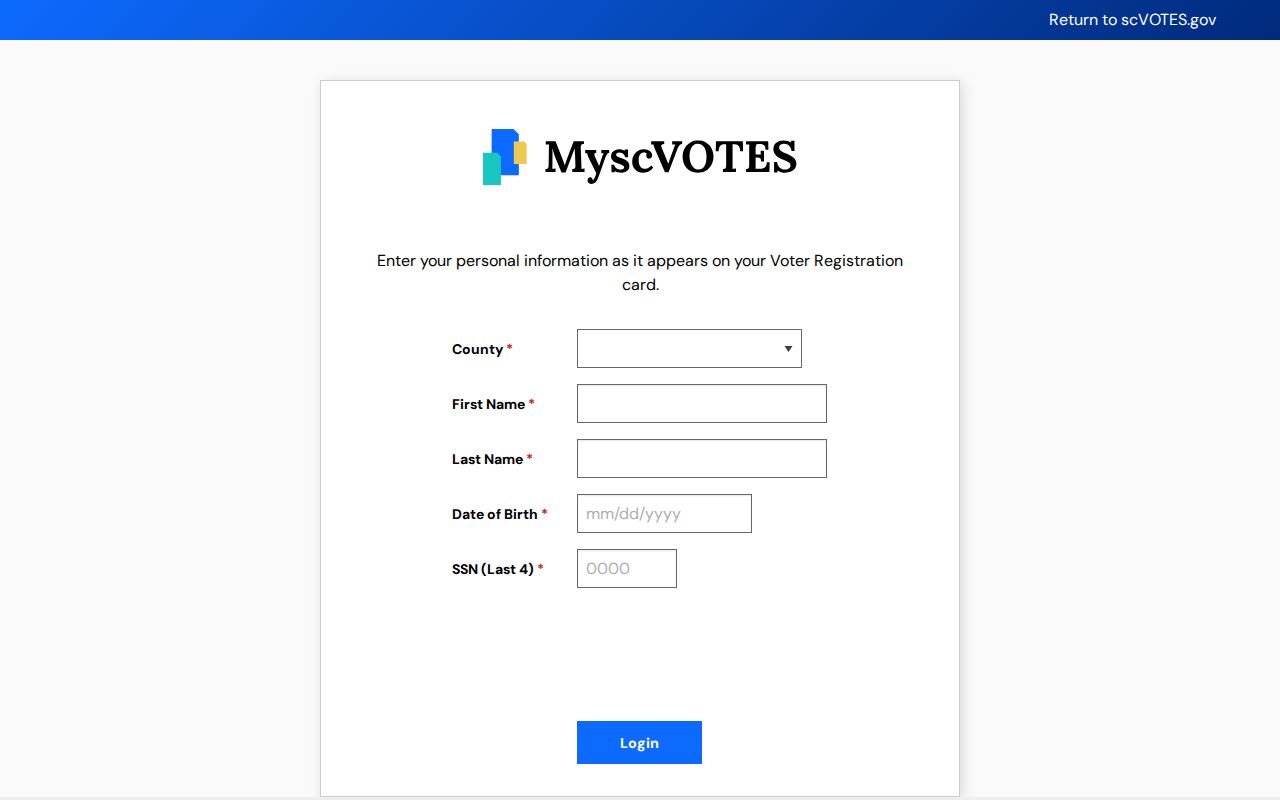
The screen points users to the current state service rather than turning registration information into a Sumter resident roster.
Sumter Court Indexes Verify Cases
The official Sumter Public Index helps locate a court case. Judicial Branch materials describe county-limited party-name and case searching, including Begins With and Contains options. The active interface was not available for a field-by-field review, so no additional form labels, document coverage, or image access should be assumed. City Municipal Court separately directs municipal matters to its Public Index route.
Start with the likely court category and County. Save the case number, caption, court level, filing or event date, and source date. Then verify the docket and document availability with the Clerk. Confidential, sealed, juvenile, protected, and expunged material may be unavailable or redacted. A name on an index does not establish identity, present location, or an outcome.
The Judicial Branch landing screen provides the official County-specific entry point.
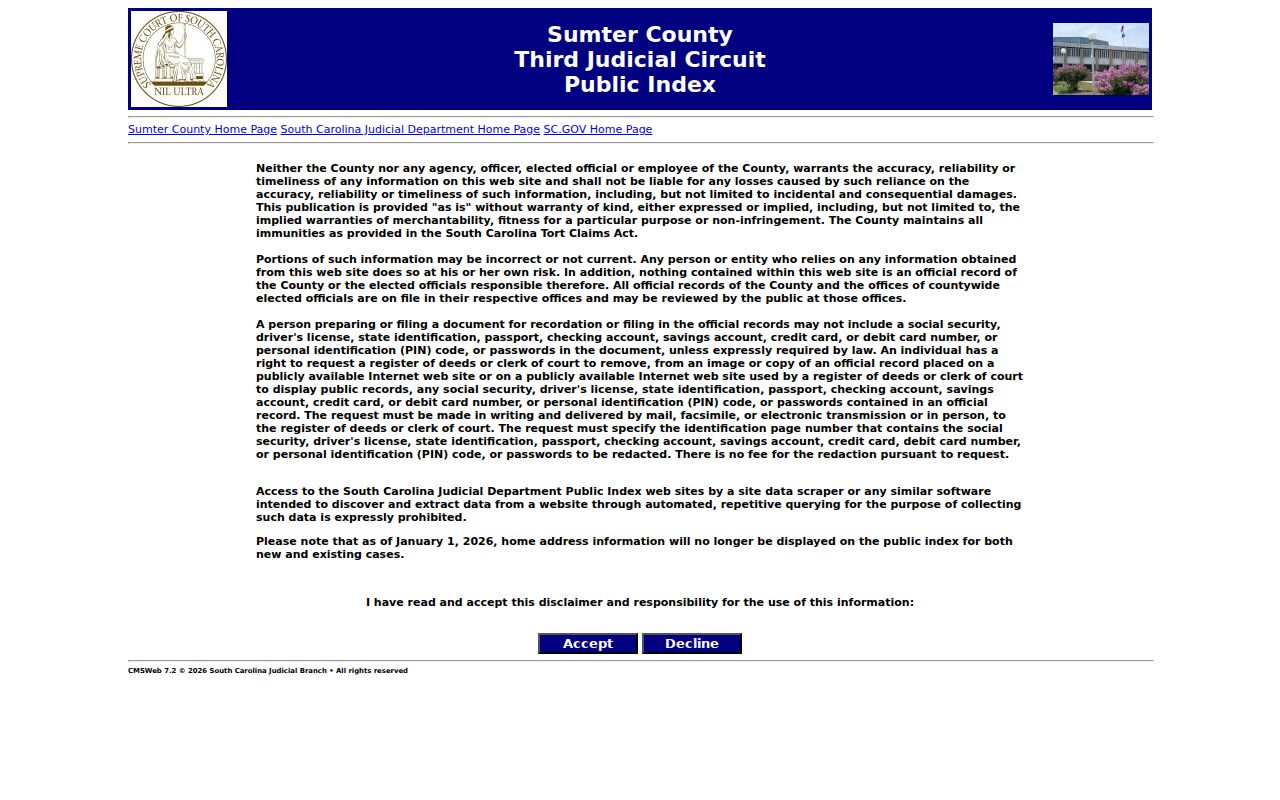
Use the index as a case-location tool, then let the Clerk confirm the actual filing or copy procedure.
Note: Courts separate dockets, filed documents, and certified copies, so ask which item is available before requesting it.
Current Sumter Resident Directory Sources
No one current directory covers every Sumter household. The public sources below have different keepers and narrower purposes. Together they form a more reliable residents-directory trail than any claim based on a single name or address. Use each source for the fact it is designed to maintain.
| Sumter source | Record relationship | Custodian | Access path |
|---|---|---|---|
| Property and mapping | Parcel and assessment lead | Sumter County | County qPublic route, live options unverified |
| Recorded instruments | Parties to land documents | Register of Deeds | County-linked Kofile gateway or office |
| Election records | Registration administration | County board and State | MySCVotes and statutory inspection route |
| Court index | Case participants and case identifiers | Judicial Branch and Clerk | Public Index, then Clerk verification |
| City administrative records | Existing municipal records | City of Sumter | Written FOIA request to the City Clerk |
For a one-person question, a Sumter resident lookup uses cross-checks and custodian limits instead of treating the list above as a profile. A missing result can mean the wrong custodian, an access restriction, a portal limitation, or a date mismatch. It does not prove that no record exists.
Sumter Vital Records Need Eligibility
South Carolina DPH is the vital-records custodian. Its Sumter location is at 105 N. Magnolia Street, Sumter, SC 29150, and its number is 803-934-2845. It is a contact point, not a general public name-search desk. DPH says birth records begin in 1915 and become available for public viewing after 100 years under S.C. Code §44-63-80. Death records become public after 50 years under §44-63-84, and the historic death index covers 1915 through 1967.
Certified copies have eligibility rules. Marriage records listed by DPH cover July 1950 through December 2023, while divorce reports listed by DPH cover July 1962 through December 2023. For a marriage outside that range, begin with Probate Court. For a final divorce decree, contact the Clerk where it was finalized. DPH’s report is not the court decree. Online, telephone, mail, and other service routes vary by record type and current notice.
The DPH birth-certificate application shows why an official request needs event and eligibility details.
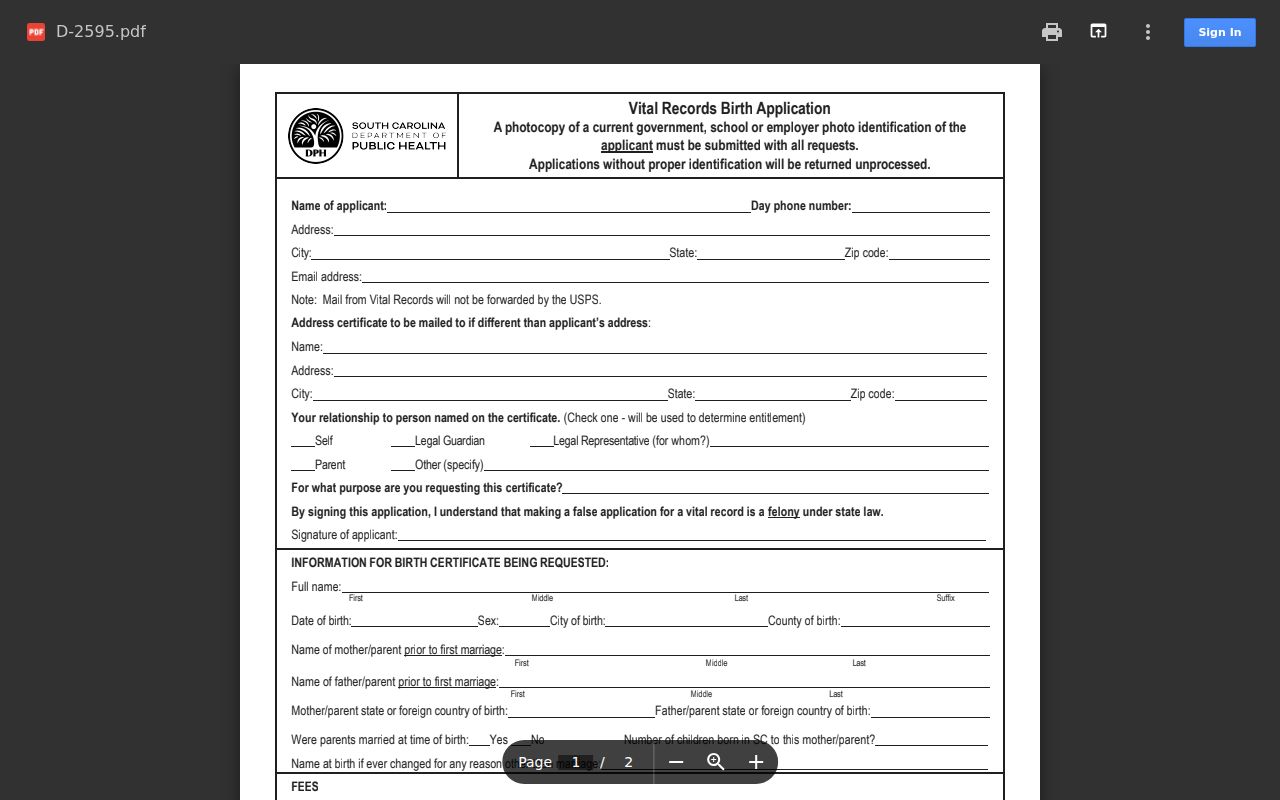
The application route keeps historical lead-finding distinct from an eligible request for a certificate.
Sumter City Requests Need Precision
The City accepts written FOIA requests in person, by mail, or by email through its FOIA page; the listed contact is foia@sumtersc.gov, routed through the City Clerk. The 2024 City form asks for a name, address, telephone number, specific record description, purpose choice, preferred format, signature, and date. It offers inspection, email, print, hard-copy, and other format choices.
South Carolina’s Freedom of Information Act, S.C. Code §30-4-10 et seq., covers existing records subject to exemptions and redactions. It does not require staff to create a record or perform open-ended research. Name the department, record type, date range, and desired copy or inspection method. Ask for an itemized estimate before costs rise. The City’s stated 10-working-day response applies to the City statement, not automatically to every County or State office.
Historical Sumter Resident Directories
The documented online historical directory is Walsh’s Directory of the City and County of Sumter, S.C., 1905-06, published by Walsh Directory Company. Its general name department, street department, classified section, and county taxpayer and post-office section offer different kinds of historical clues. A general entry can associate a name with residence and occupation, while the street department organizes an address with an occupant or use.
That volume does not establish a continuous directory run or a current household. The Sumter County Library, at 111 N. Harvin Street, offers reference and database assistance. The Sumter Museum Archives, at 122 N. Washington Street, asks researchers to arrange appointments and directs genealogy inquiries to the Sumter County Genealogical Society. The full collection and reading method belong on the Sumter city directory page.
Old Sumter District Research Context
The Sumter Museum Archives has a documented scope from 1740 to the present, including old Sumter District material, journals, diaries, correspondence, photographs, military resources, plats, and Sanborn maps. The old district included territory now associated with Clarendon, Lee, and Sumter counties. For an early family or property question, use that historical jurisdiction in an archive inquiry instead of assuming a modern County label captures every record.
The Library of Congress 1902 Sanborn set has nine Sumter sheets. It can help compare streets, building footprints, and historical use, but it is not a title record or a modern mailing-address tool. Pair a dated map with a directory, parcel, plat, or recorded instrument. Sumter Museum, Library, and SCDAH staff can help determine whether a manuscript, photograph, or archive catalogue entry offers a next step.
Protecting Sumter Record Boundaries
Public availability does not authorize unlimited reuse. Vital records have eligibility and historical-access periods. Court files can be sealed or redacted. South Carolina’s Address Confidentiality Program provides a substitute mailing address and mail forwarding for eligible survivors of specified crimes. The program does not erase prior records, and custodian rules still control the display and correction of an address.
If an official record has an error, contact the office that owns it: mapping or assessment for a parcel display, the Register of Deeds for an instrument, the Clerk for a filing, DPH for a vital record, or the election office for registration. The South Carolina Address Confidentiality Program is the official protection route for people who may qualify.
Sumter Research Notes Keep Sources Clear
Sumter portals and office procedures can change without changing the record itself. The County property route, Kofile gateway, Public Index, MySCVotes, and detention route all had an access or live-interface limitation during research. Record the source title, full URL, date viewed, custodian, search or request identifier, coverage statement, access condition, and unanswered question. A result note should also preserve the record date and its identifier.
That practice matters when a link fails, a name is common, or a historic address looks unlike a present one. State what was actually checked, then choose the next custodian rather than filling a gap with an assumption. For a City question, keep the request with the City Clerk or department. For a County instrument, use the Register of Deeds. For a court document, return to the Clerk. This is a practical way to keep a Sumter residents directory trail accurate over time.
For an archive inquiry, add name variants, the historical jurisdiction, the address as written, the dated directory or map already checked, and a precise question. For a public-record request, preserve the office response, estimate, and date. These small details make a later correction or handoff possible without recreating a vague search.